RACKVISION / TECHNOLOGY
Technology designed for long-term monitoring.
Purpose-built wireless sensors, local data processing and an independent data layer provide the reliable technological foundation behind RackVision.
01 / PURPOSE-BUILT WIRELESS SENSOR
RackVision sensor for static structures.
Battery-powered wireless sensors with MEMS accelerometers are designed for long-term monitoring without the need for complex cabling.
The sensors form part of a distributed monitoring system. Depending on the configuration, they can operate independently or work together with neighbouring sensors to provide more precise information about the location and nature of a recorded event.
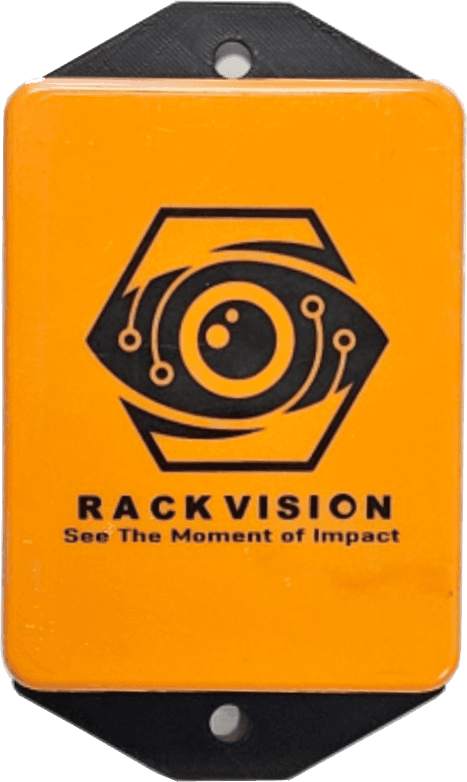
MEMS
Sensitive detection of mechanical shocks and vibration.
≈ 3 years
Typical battery life depending on configuration and operating conditions.
CLASSIFICATION OF RECORDED EVENTS
Green – Normal operation
Routine mechanical events with no expected impact on the structure. No action required.
Yellow – Increased attention
Events that should be inspected, with potential risk if they occur repeatedly.
Red – Critical event
A significant impact with a potential risk of structural damage. Immediate inspection required.
02 / SENSOR COLLABORATION
The event is evaluated in context, not as an isolated point.
Multiple sensors installed on the same structure can work together when evaluating a single event. This helps identify more precisely which area should be inspected.

03 / CAMERA SYSTEM INTEGRATION
RackVision can be integrated with an existing or newly installed camera system. A recorded event can therefore be linked to a short video clip from the relevant camera, adding visual context to information about the location and intensity of the impact.
Existing cameras
Compatible customer camera infrastructure can be used where available.
New installation
Cameras can also be supplied as part of a new RackVision solution.
Event + video
A short video clip helps provide a clearer understanding of the circumstances surrounding an impact.
A camera system is not required for RackVision to operate. Video is an optional additional layer.

04 / SCALE AND COVERAGE
Architecture designed for large industrial environments.
Up to 10,000 m²
Typical coverage depending on building layout and local conditions.
Tens to hundreds
of sensors within a single scalable installation.
Start with a pilot
and expand the system according to results and operational requirements.
05 / INDEPENDENT DATA LAYER
No access to the customer’s LAN or Wi-Fi required.
RackVision can operate independently of the customer’s existing data network. It uses its own communication infrastructure and independent data connectivity.
RackVision sensors
↓
Local RackVision infrastructure
↓
Independent data connectivity
↓
RackVision dashboard
Customer LAN not required
Customer Wi-Fi not required
06 / LOCAL PROCESSING
A dedicated local unit for every installation.
Each installation includes its own RackVision control and data unit, ensuring that the system operates directly on site.
It handles:
Event reception from sensors · Data processing · Historical data storage · System services · Communication with the user interface
07 / MODULAR ARCHITECTURE
Start with a pilot. Expand based on results.
Pilot area
Expansion
Entire operation
Multiple sites
RackVision does not need to be deployed across the entire facility from day one. A pilot installation makes it possible to verify the benefits first and then expand the system naturally according to operational needs.
